
If you open Google Ads for the first time, you’ll probably feel one thing: “This is a lot.”
The dashboard looks like a cockpit. Buttons everywhere. Charts everywhere. Too many settings you’re scared to touch.
But here’s the good news: Google Ads is not “hard.” It’s just layered. And once you understand the fundamentals, everything becomes simpler.
Table of Contents. Don't worry about hurting my feelings if you want to skip around.
If you prefer watching this explained in Arabic (instead of reading), you can watch the video below.
1) Google Ads account structure (the foundation)
Before keywords, bidding, and optimization, you need to understand how a Google Ads account is organized.
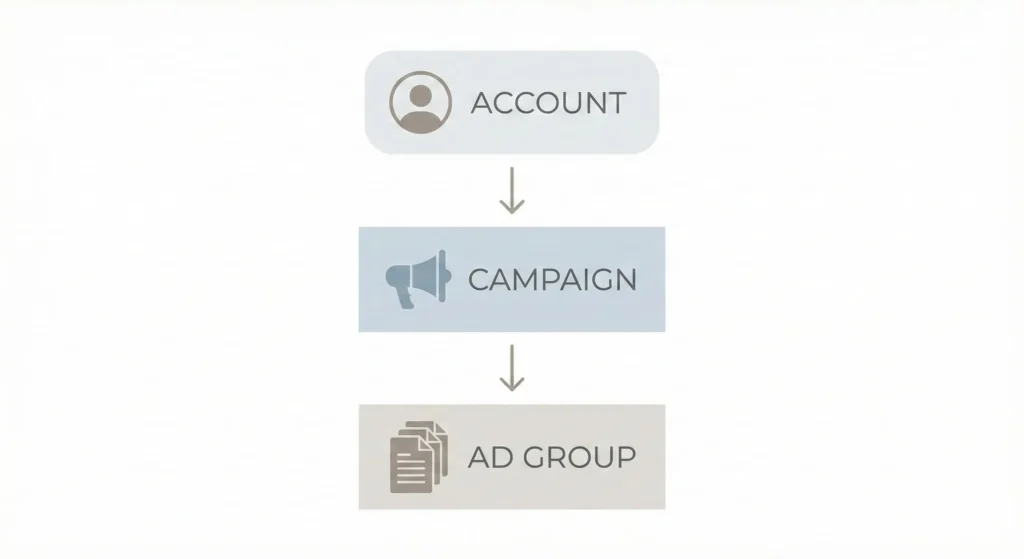
Google Ads has a strict hierarchy:
Account level
This is the business level.
Anything you configure at the account level can influence everything underneath it. Examples:
Billing and payments
Access and permissions (who can manage the account)
Linked accounts (like Google Analytics, Merchant Center, and other integrations)
Shared assets (depending on setup), things you reuse across campaigns
Think of it like the “company settings” layer.
Campaign level
Inside the account, you build campaigns.
This is where you choose your objective (leads, sales, etc.) but more importantly, this is where you set your budget.
That matters because budget is fuel, and campaigns need data to learn. In 2026, we’re in the age of less is more.
When you split your account into too many campaigns, you fragment your data and slow down learning. Whenever it makes sense, consolidate so the system can collect conversion data faster inside one place.
Ad group level
Inside each campaign, you have ad groups.
An ad group is basically a “theme bucket.” It contains:
Your keywords (grouped by intent/theme)
Your ads (headlines, descriptions, and assets)
What are “assets” in simple terms?
Assets are the building blocks Google uses to assemble your ads. In Search, this is typically things like your headlines and descriptions, plus extensions like sitelinks, callouts, structured snippets, and more.
The point is: you’re not writing one static ad anymore. You’re giving Google components to test and mix in different auctions.
Example of keywords grouped by theme
Let’s say you’re a dental clinic.
You don’t want one ad group with everything mixed together.
A clean structure would look like:
Ad group 1: “Teeth whitening” keywords (whitening, whitening dentist, teeth whitening near me)
Ad group 2: “Dental implants” keywords (implants, dental implant cost, implants clinic)
Ad group 3: “Emergency dentist” keywords (emergency dentist, tooth pain urgent)
Each theme gets its own messaging, its own landing page, and clearer relevance. Relevance is the name of the game in Google Ads fundamentals.
2) The Google Ads auction (it’s not “who pays more”)
A lot of people misunderstand how Google Ads works. They assume it’s a normal auction.
In a normal auction, whoever has the biggest wallet wins.
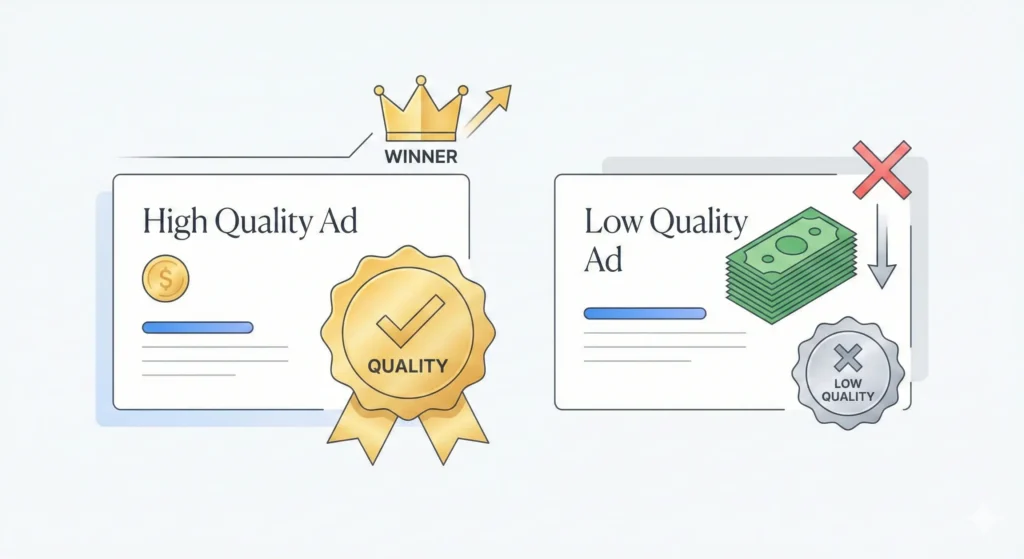
In Google Ads, the highest bidder does not always get the top spot.
Google uses Ad Rank to decide:
whether your ad shows
where it shows
and how competitive you are in that specific auction
Google explains that Ad Rank uses your bid and auction-time quality signals (like expected clickthrough rate, ad relevance, and landing page experience), and it’s recalculated for every search and every position.
Quality Score, and why it’s core to Search fundamentals
Quality Score is one of the most important concepts in Google Ads fundamentals, especially in Search.
Why?
Because it’s Google’s way of summarizing how relevant and useful your keyword + ad + landing page experience are likely to be.
You can think of it like this:
If your ad is a perfect match to what the person is searching for, Google rewards you
Better relevance usually means better efficiency (better positions at a lower cost)
So yes, sometimes a smaller advertiser can beat a bigger one, not because they spent more, but because they built a better experience.
3) Where Google Ads can appear
When people say “Google Ads,” they usually mean Search ads.
Search is still the main battlefield. But placements are not what they used to be. There’s more competition, and often fewer obvious slots on the page, depending on the query.
That said, if your structure and relevance are strong, you’ll be fine.
Beyond Search results, Google Ads can also show on:
YouTube
Gmail
Display Network (websites and apps)
Shopping placements for ecommerce
You choose where you show based on your campaign type and settings.
4) Targeting (what you control)
To reach the right people, you can target using signals like:
Location (country, city, radius)
Demographics (age, gender), when it’s relevant to your offer
Yes, you can segment by device (mobile vs desktop). But unless you have a strong, proven reason backed by data, keep it simple and don’t over-segment.
The more you fragment your campaigns, the slower your learning becomes.
5) Keyword match types (why “Exact” isn’t exact anymore)
This is where most Google Ads for beginners get confused.
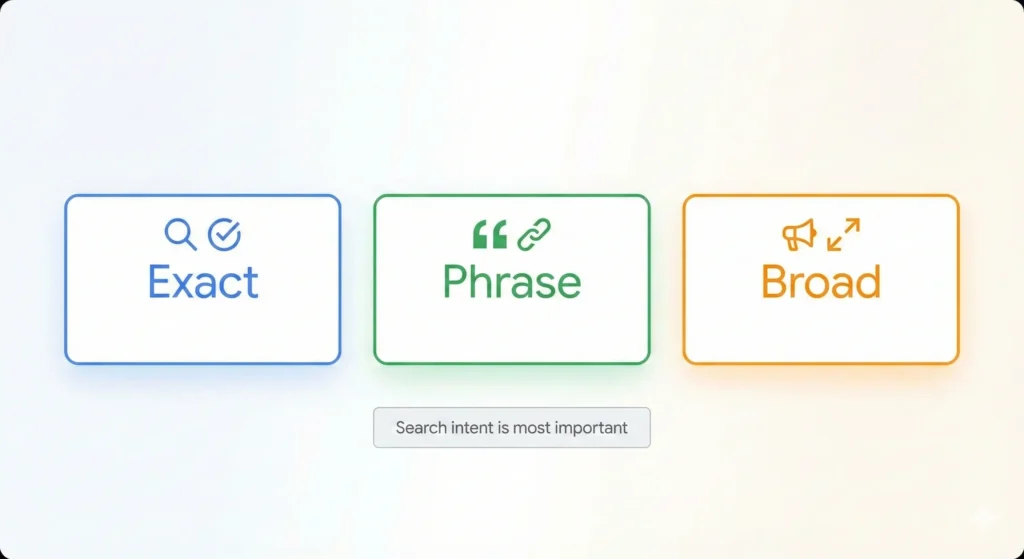
Google has three main match types:
Exact match
Phrase match
Broad match
At first glance, they look simple. But the way they actually behave today is different from how many people think they work.
The important shift
Over time, Google has leaned much more into meaning and intent, not just literal wording.
That’s why an “exact match” keyword can trigger ads for searches that aren’t typed word-for-word the same way as long as Google determines the intent behind the search is similar.
In other words, Google is optimizing for what the user means, not just what they typed.
You’ll also notice that Google often recommends using Broad Match together with Smart Bidding. And in the right accounts, with strong data and proper tracking, that combination can perform very well.
But here’s the key takeaway:
Just because Google recommends something doesn’t mean it’s automatically correct for your account.
There are no hacks.
No magic match type.
No universal “secret structure.”
This shift toward automation and machine learning isn’t unique to Google either. We’re seeing the same consolidation trend across platforms. For example, Meta pushed heavily into algorithm-driven optimization with its Andromeda update a move toward giving the system more control and relying on stronger data signals.
The pattern is clear: platforms are evolving toward automation, intent-based matching, and consolidation.
Which means your competitive advantage isn’t a trick.
You win by understanding the fundamentals:
Your account structure
How the auction works
Your relevance
Your landing page experience
And your conversion signals
When those are strong, match types become a strategic lever not a gamble.
Final note
If you’re starting out, don’t try to master every feature.
Master the fundamentals first.
Because there is no hack.
There is no secret setting.
There is no one campaign structure that magically works forever.
Platforms evolve.
Automation increases.
Competition gets tighter.
But if you understand how Google Ads actually works the structure, the auction, the relevance, the intent you’ll stay competitive long-term, even as the platform changes.
Fundamentals don’t expire.