Table of Contents
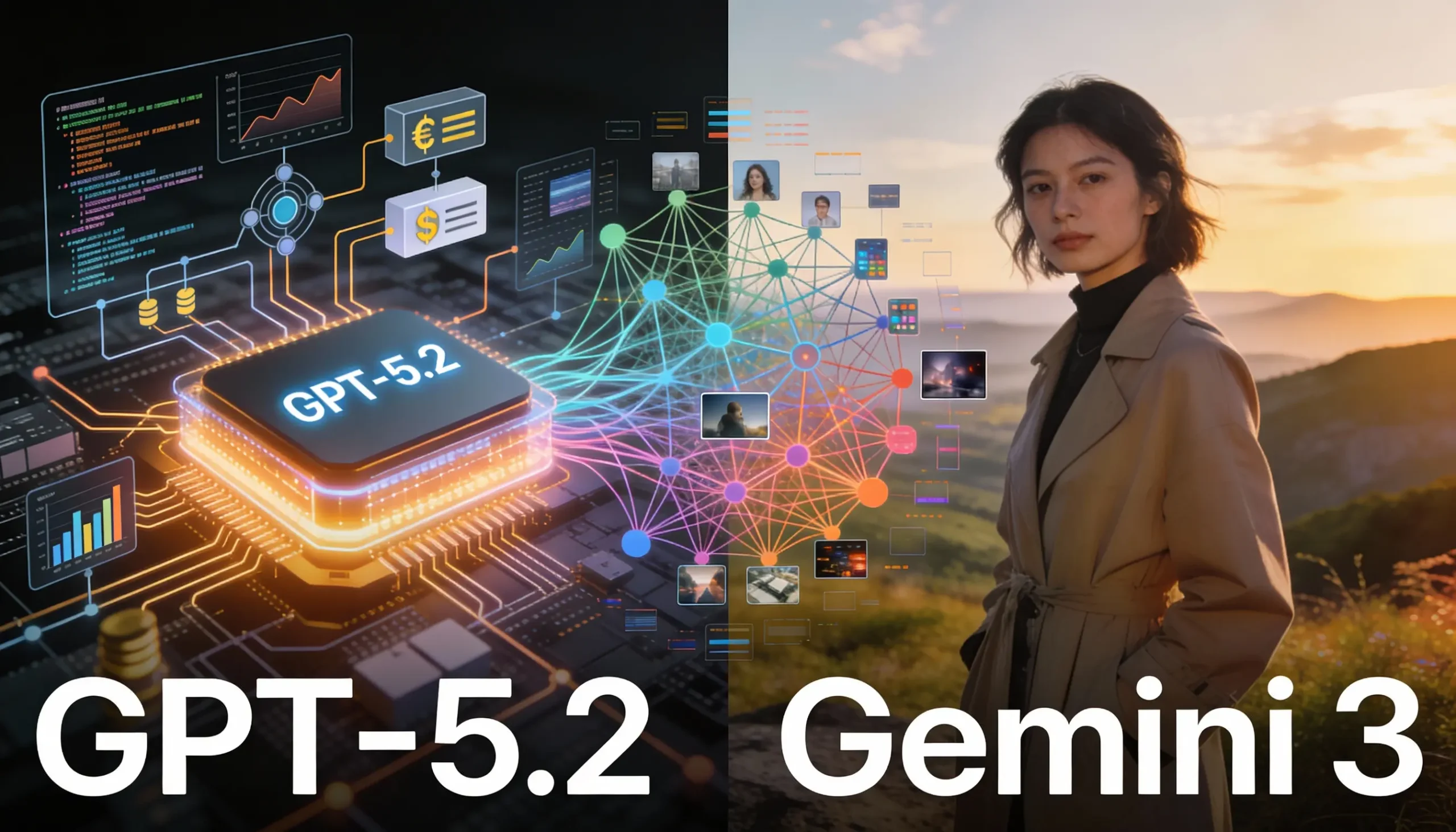
On December 11, 2025, OpenAI redefined the generative AI landscape with the official launch of the GPT-5.2 model series. While previous updates focused on incremental gains, GPT-5.2 represents a paradigm shift in “Agentic” workflows, specifically targeting the dominance held by competitors like Google’s Gemini 3 in long-context reasoning.
For SEO professionals, developers, and enterprise architects, this update introduces three distinct model tiers: Instant, Thinking, and Pro, along with a new “GDPval” economic benchmark that claims to outperform human experts in professional tasks.
The Competitive Landscape: GPT-5.2 vs. Gemini 3
The AI market is currently a two-horse race. With the release of GPT-5.2, OpenAI is directly challenging the multi-modal capabilities of Google’s Gemini 3. Below is a breakdown of how the new “Thinking” model stacks up against the current high-end competition.
| Feature / Metric | GPT-5.2 Thinking | Google Gemini 3 (Ultra) | GPT-5.1 (Legacy) |
|---|---|---|---|
| Primary Focus | Deep Reasoning & Agentic Workflows | Native Multi-modality & Massive Context | General Purpose Chat |
| Context Window Accuracy | ~100% (up to 256k tokens) | High (up to 2M tokens) | Degrades after 64k tokens |
| Math (AIME 2025) | 100% (Perfect Score) | ~96-98% | 94.0% |
| Coding (SWE-bench Verified) | 80.0% | Competitive (High 70s) | 76.3% |
While Gemini 3 retains an advantage in raw context window size (processing millions of tokens), GPT-5.2 Thinking claims a victory in precision reasoning within its 256k window, achieving a perfect 100% score on the AIME 2025 math benchmark without using external tools.
Detailed Model Breakdown
OpenAI has segmented the GPT-5.2 release to optimize for cost versus capability, creating a tiered ecosystem for developers and users:
1. GPT-5.2 Instant
Designed to compete with lightweight models like Gemini Flash. It offers the lowest latency for “how-to” queries and technical writing. It is the default for Free and Plus users who need quick answers without deep logic chains.
2. GPT-5.2 Thinking
The new industry standard for professional work. This model introduces enhanced “Tool Calling” reliability, making it ideal for:
- Financial Modeling: Creating complex spreadsheets with proper formatting and formulas, crucial for data-driven marketing.
- Data Science: Analyzing scattered data points across long documents with high fidelity.
- Agentic Tasks: Autonomously handling multi-step workflows (e.g., booking flights + updating calendars + sending emails).
3. GPT-5.2 Pro
The “maximum compute” model. It prioritizes accuracy over speed, significantly reducing hallucination rates in specialized fields like law, medicine, and advanced software engineering.
Real-World Application: The “GDPval” & Economy
In a bold move, OpenAI introduced a new benchmark called GDPval, designed to measure AI performance against human professionals across 44 occupations.
“GPT-5.2 Thinking beat or tied human experts in 70.9% of professional knowledge tasks, while operating at >11x the speed and <1% of the cost.”
For businesses, this metric suggests that GPT-5.2 is no longer just a “helper” but a viable replacement for specific Tier-1 tasks. Companies should now assess their digital strategy to integrate these cost-saving capabilities.
API Pricing & Context Caching
Despite the performance leap, OpenAI has maintained aggressive pricing to stay competitive with Google and Anthropic. The new pricing structure incentivizes “Context Caching” for heavy users.
| Model Tier | Input Cost / 1M Tokens | Cached Input (90% Off) | Output Cost / 1M Tokens |
|---|---|---|---|
| GPT-5.2 (Instant/Thinking) | $1.75 | $0.175 | $14.00 |
| GPT-5.2 Pro | $21.00 | N/A | $168.00 |
Beyond the Benchmarks: Language & Usability
While benchmarks tell a story of raw power, day-to-day usability reveals critical differences that businesses must consider:
- Multilingual Mastery: Gemini 3 retains a significant edge in non-English tasks. Its training on diverse global datasets makes it superior for nuanced translation in languages like Arabic and Mandarin, whereas GPT-5.2 still exhibits an “English-centric” logic bias in complex cultural contexts.
- Privacy & Memory: GPT-5.2 introduces granular “Memory Management,” allowing users to delete specific facts the model remembers. In contrast, Gemini relies on broader Google Account activity controls, which can be less precise for individual users concerned with data privacy.
- Sustainability: The “Thinking” process in GPT-5.2 is energy-intensive. For organizations with strict green IT goals, Gemini Flash/Standard models offer a significantly lower carbon footprint per query compared to the high-compute GPT-5.2 Pro.
Final Verdict: Which Should You Choose?
GPT-5.2 closes the gap with Gemini 3 in terms of multi-modal understanding and surpasses it in pure logical reasoning and coding benchmarks.
Choose GPT-5.2 if: You are a developer or enterprise needing precise “Thinking” capabilities for complex logic, agentic workflows, or financial modeling.
Choose Gemini 3 if: You are deep in the Google Workspace ecosystem, require massive context windows (reading entire books/repos), or rely heavily on multilingual translation.
For developers and SEOs, the introduction of Context Caching in GPT-5.2 makes building complex, data-heavy applications significantly cheaper, signaling a shift from “chatbots” to true “AI Agents.”